

The headless vs traditional website question comes up in nearly every discovery call Vulture Concepts runs in 2026, and it rarely has a one-line answer. The choice depends on content workflows, integrations, team capability, budget, and where the site needs to go over the next few years.
Table Of Contents
- 1. What Is a Traditional Website?
- 2. What Is a Headless Website?
- 3. Core Differences
- 4.When Traditional Makes More Sense
- 5.When Headless Makes More Sense
- 6. Headless Website Development for Businesses
- 7. Headless WordPress Development Services in India
- 8.Choosing a Web Development Company
- 9. Cost and Complexity
- 10. Decision Framework
- 11. FAQs
What is a traditional Website?
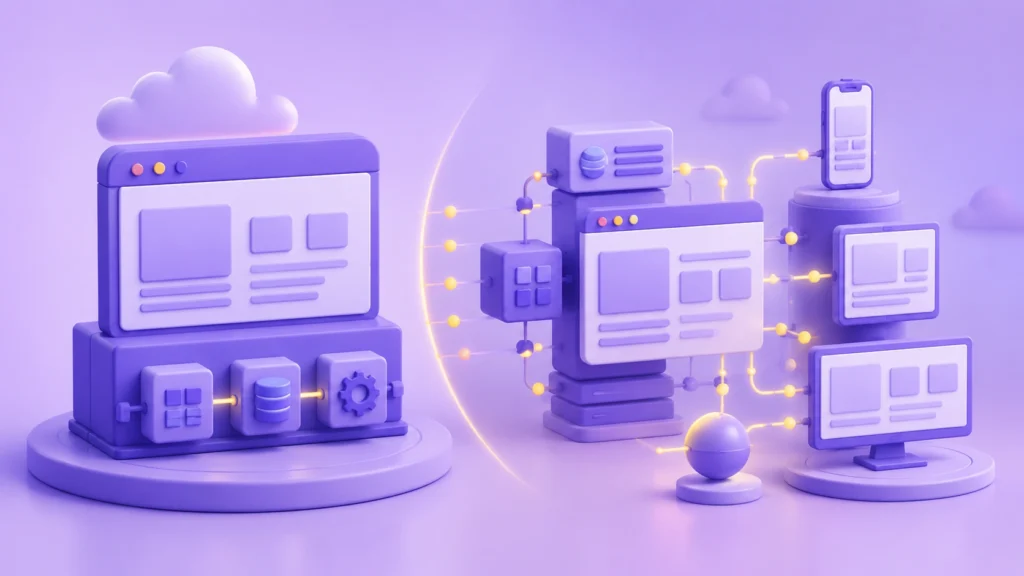
A traditional website uses one system, usually a CMS like WordPress, where the backend and frontend are tightly integrated. Templates pull content from the database and render finished pages directly. This model has run most of the web for two decades because it is predictable: editors work in a familiar dashboard, and plugins add functionality without custom development. For a business needing one site with a blog, service pages, and a contact form, this remains a practical, well-understood approach.
What Is a Headless Website?
A headless website separates content management from presentation. The backend, often a headless CMS, stores content and exposes it through an API instead of rendering pages directly. A separate frontend, built with a framework like Next.js or Astro, requests that content and controls how it displays, a pattern often called decoupled or API first architecture. The same content can feed a website, an app, and other channels from one backend.
Core Differences
Neither approach is automatically faster, safer, or better; a poorly built headless site can be slower than a well-optimized traditional one, and a traditional site with good caching performs well.
| Factor | Traditional | Headless |
|---|---|---|
| Frontend flexibility | Limited to theme | High, built independently |
| Content management | One familiar dashboard | CMS plus separate frontend |
| Performance | Good with caching | Strong if well built |
| Integrations | Plugin ecosystem | Easier, API first |
| Team needs | Comfortable for editors | Requires developers |
| Time to launch | Typically faster | Typically longer |
When Traditional Makes More Sense?
Small businesses, local service providers, and marketing-led sites rarely need decoupled complexity. If the team wants to edit pages and publish posts without a developer, a traditional CMS keeps that simple. Content-focused sites with one frontend and a small team are almost always better served by traditional website development.
When Headless Makes More Sense?
Headless website development earns its complexity once content needs to reach multiple touchpoints, such as a website, an app, and an in-store display, from one source. It also suits highly custom frontends a template CMS cannot support. The tradeoff: these projects need developers who can maintain both the CMS and frontend, plus a plan for previewing content across systems.
Headless Website Development for Businesses
Before committing to headless website development for businesses, a few questions help: Does the frontend need freedom the current CMS cannot give? Will multiple platforms consume the same content? Can the team support two systems long term? Does the expected value outweigh the extra maintenance? If most answers point to one frontend and a small team, traditional is usually the sensible start.
Headless WordPress Development Services in India
WordPress can run as a pure content backend while a separate frontend handles display. This is what most headless WordPress website development services in India actually build: WordPress exposes content through the WordPress REST API, and a frontend framework retrieves it using standard Fetch API requests. This setup needs preview workflows for draft content, plugin compatibility since many plugins assume a traditional frontend, and technical SEO the frontend must now manage itself. Headless WordPress is not automatically superior to conventional WordPress; it fits when a business genuinely needs frontend flexibility a theme cannot deliver.
Choosing a Web Development Company
When evaluating a Web Development Company in Ahmedabad or elsewhere in India, look past the portfolio and ask about architecture experience specifically. A capable partner runs discovery mapping content needs and growth plans before recommending traditional or headless, and explains the tradeoffs in plain language. Ask how they handle SEO in either architecture, since Google’s JavaScript SEO guidance applies differently depending on rendering. Among the Best Web Development Company in India options, the ones worth shortlisting recommend the simpler architecture when it fits, rather than defaulting to what they prefer to build. Vulture Concepts approaches this the same way, starting from the client’s actual workflow
Cost and Complexity
Pro Tip: Before choosing headless, validate content workflows, required integrations, SEO requirements, team capability, and maintenance capacity. These factors, more than any performance benchmark, determine whether a headless build succeeds or becomes a burden within a year.
Development cost is only part of the picture. Headless builds usually need separate hosting, more testing, and developers who understand both API design and frontend frameworks. Traditional builds cost less upfront and rely on widely available WordPress skills, but can hit limits when custom integrations appear later. The lowest initial price is not always the lowest total cost.
Decision Framework
| Situation | Likely Better Fit |
|---|---|
| Small business, single site, non-technical editors | Traditional |
| Fast launch, limited budget | Traditional |
| Content feeding multiple apps or platforms | Headless |
| Highly custom, interactive frontend | Headless |
| Complex integrations with several systems | Headless |
| Small team without frontend developers | Traditional |
Key Takeaways
• Traditional and headless are architectural choices, not old versus new.
• Traditional suits most small and mid-sized businesses needing one clear frontend.
• Headless pays off when content must reach several platforms.
• Team capability and maintenance plans matter as much as the technology itself.
Conclusion
There is no universal winner in the headless vs traditional website debate. Traditional architecture remains effective for businesses needing one well-managed site with straightforward editing. Headless website development becomes worthwhile once flexibility, complex integrations, or a custom frontend justify the added cost. Vulture Concepts works through this decision with each client based on actual workflow, not a default answer. If you are weighing your options, contact Vulture Concepts to discuss your project.
Frequently Asked Questions
What is the core difference between headless and traditional websites?
Traditional manages content and presentation together; headless separates them via an API.
Is headless better for WordPress sites?
Not automatically. It suits businesses needing frontend flexibility a theme cannot provide.
Does headless architecture help or hurt SEO?
Neither by default. Outcomes depend on rendering and metadata, not the label.
Is headless website development more expensive?
Usually, due to separate hosting, more testing, and developers for both systems.
What kind of business benefits most from headless?
Organizations distributing content across a website, an app, and other channels from one backend.
Does headless mean better performance?
Not automatically. Performance depends on how the frontend is built.
Is headless worthwhile for a small business?
Usually not yet. Most small businesses are better served by a well-built traditional website.