
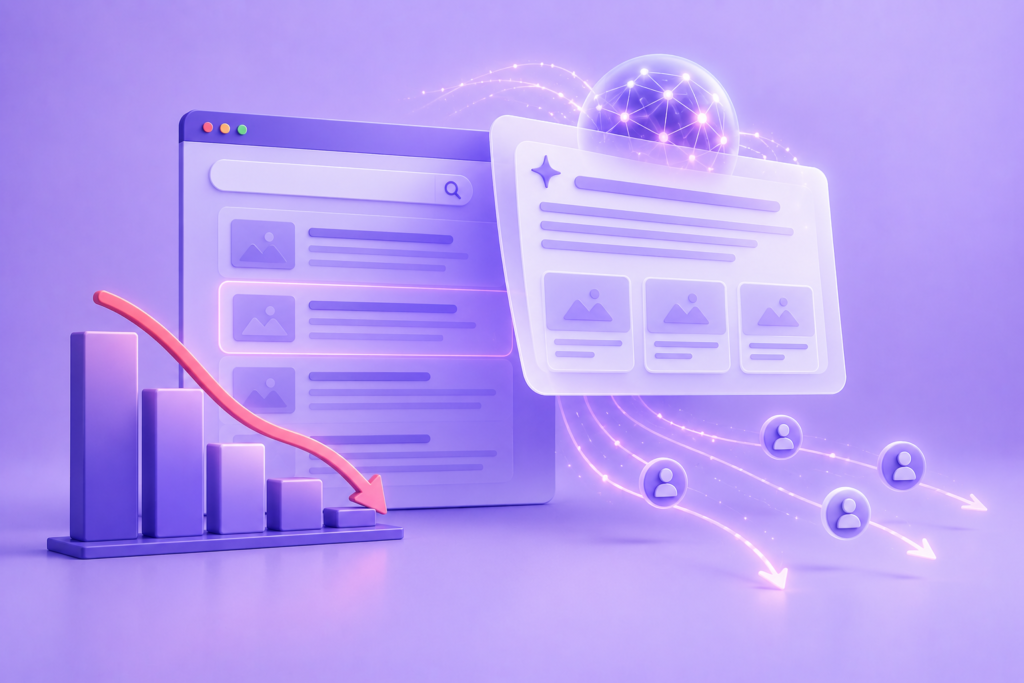
Your Search Console line is sloping down, yet your rankings look fine. That pattern sits behind most Google AI Overviews traffic loss, and it rarely means your SEO has failed. The results page itself has changed, with answers appearing before links. Vulture Concepts helps businesses interpret this shift, so this guide shows how to diagnose it and respond.
Table Of Contents
What Are Google AI Overviews?
Google AI Overviews are generated summaries shown above some search results, with links to supporting pages. They do not appear for every query. Google’s guide to AI features and your website explains how they work for site owners.
Why AI Overviews Reduce Clicks
When a summary answers the question, many people stop reading. This is zero-click search: the user gets what they need on the results page, so your page may be cited yet unvisited.
Simple informational content is most exposed, such as definitions, quick how tos and basic comparisons. Pages offering original data, tools, worked examples, or professional judgement give people a reason to click through.
Are Your Rankings Really Falling?
Often, no. Impressions can hold steady while clicks fall, because your page still appears but fewer people choose it. Position alone also misleads, since an AI answer can sit above your number one result. Google says AI features are counted in the Performance report in Search Console, under the Web search type.
Judge impressions, clicks, CTR, average position, conversions, and branded searches together. Steady impressions with falling CTR points to a changed results page. Falling impressions and position point to a genuine ranking problem.
How Search Behavior Is Changing
People ask longer, conversational questions and expect a direct answer first. They may use the overview to get oriented, then click only for detail, proof, or a purchase. Visitors who arrive can be further along in their decision, so check conversions before declaring a loss.
How to Recover Organic Traffic
- Check Google Search Console. Open the Performance report and compare equal periods before and after the drop.
- Compare clicks and impressions. Stable impressions with fewer clicks suggest a results page change.
- Review CTR changes. Sort queries by CTR decline to see where clicks disappeared.
- Identify affected queries. Group them as informational, commercial, or branded.
- Analyze lost content. Look for pages that only answer short factual questions.
- Improve depth and originality. Add firsthand experience, data, examples, and expert commentary.
- Strengthen internal linking and topical authority. Link related pages so topics connect clearly and content stays easy to find.
- Optimize for AI search visibility. Use descriptive headings, direct definitions followed by depth, and accurate facts. Google says no special schema is needed.
- Measure conversions. Track calls, forms, and sales in Analytics, not traffic alone.
Pro Tip:
Export queries for two equal date ranges and tag each as informational, commercial, or branded. Where impressions rise, but CTR drops, AI answers are probably absorbing clicks. Note the dates in your report so you never blame the wrong cause later.
Adapting SEO for AI Search
AI SEO differs from traditional SEO in its goal. Traditional SEO earns rankings and clicks. Google AI Overview SEO also asks whether your facts, brand, and expertise are clear enough to be cited. Both depend on crawlable pages, strong topical coverage, and people-first content. Businesses need both, because other answer engines such as ChatGPT and Perplexity use their own methods and reward consistent, accurate information.
When to Consider AI SEO Services
Consider outside help when the cause is unclear, revenue is affected, or your team cannot rework content at scale. When comparing an SEO Company in India, ask how they separate ranking loss from click loss. As an SEO Company in Ahmedabad, Vulture Concepts offers AI SEO services and AI Overview SEO services built on analysis first, not promises.
Key Takeaways
- Falling clicks do not always mean falling rankings.
- Read impressions, clicks, CTR, position, and conversions together.
- Simple informational pages are most exposed to zero-click answers.
- Original, expert content gives people a reason to visit.
- Traditional SEO and AI search optimization work best together.
- Measure leads and sales, not traffic alone.
Frequently Asked Questions
1. Are websites getting less traffic because of AI?
Some are, especially on simple informational queries where an AI summary answers the question. Check Search Console for stable impressions with lower CTR, then compare conversions, since traffic quality may differ from raw visit numbers.
2. Why did I lose my AI Overview on Google?
Overviews are generated per query and do not appear for every search. Cited sources can change as answers update, competitors publish stronger pages, or your content becomes outdated. Nobody can guarantee inclusion, so keep pages accurate, original, and well linked.
3. Is AI killing web traffic?
Not outright. Search behavior is shifting, and some content types lose clicks. Websites offering original data, experience, tools, and depth still give people reasons to visit. The practical response is adapting your content and measurement rather than abandoning SEO.
4. Is Google losing money on AI Overview?
There is no public financial breakdown for AI Overviews, so any answer is speculation. For website owners, the more useful question is how these answers change clicks and conversions on your own pages.
5. How do Google AI Overviews affect SEO?
They change how visibility is measured. Rankings still matter, but clicks may fall even when positions hold. Google says SEO fundamentals remain relevant, so focus on helpful content, internal links, clear structure and conversions, and read Search Console data in context.
Conclusion
Google search behavior is changing, but traffic loss does not automatically mean SEO failure. Understand clicks, impressions, CTR, rankings, conversions, and AI search visibility together. Traditional SEO remains important, and AI search optimization is becoming part of modern visibility. The safest strategy is original, expert-led content that gives people a reason to visit. Vulture Concepts can help you build that plan.