
Introduction
The digital marketing landscape looks fundamentally different today than it did even twelve months ago. If you are managing a brand or running a marketing team in 2026, you have likely noticed that traditional strategies are losing their edge. Generative AI has evolved from a novelty tool into an operational foundation.
We are no longer just asking an AI to draft a social media post or brainstorm a few blog topics. Instead, the industry has shifted toward intelligent systems that connect separate platforms, analyze multi-channel data, and execute complex campaigns with minimal manual intervention. Navigating this change requires understanding how interconnected AI systems are reshaping how brands communicate with their audiences.
What Is AI Workflow Automation?
To understand this shift, it helps to distinguish between using isolated AI tools and implementing true AI workflow automation. Buying a subscription to a copywriting tool or an image generator gives you a point solution. You still have to prompt the tool, copy the output, format it, log into your content management system, and manually schedule the post.
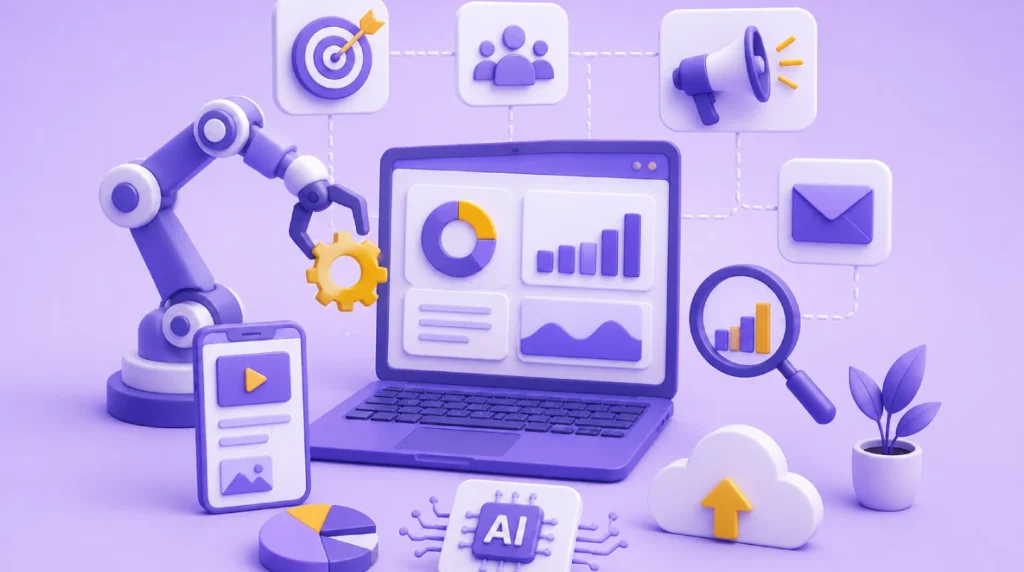
True automation connects these fragmented steps into a cohesive, self-sustaining loop. An automated workflow uses specialized AI agents that communicate with each other through APIs. For example, a workflow can automatically monitor your website analytics, detect a drop in traffic for a specific product, instruct a research agent to analyze competitor trends, generate an optimized content brief, and queue a draft in your content management system for human review.
Businesses are adopting these automated ecosystems to eliminate operational friction. By connecting data ingestion directly to execution engines, companies can respond to market changes in minutes rather than weeks.
Why Traditional Digital Marketing Is No Longer Enough?
Many marketing teams currently face severe operational bottlenecks. We have noticed a common pattern where talented creators spend more time managing spreadsheets, updating project boards, and moving data between mismatched software platforms than they do on actual strategy. This tool fragmentation creates massive data silos, making real-time reporting nearly impossible.
At the same time, customer expectations have reached an all-time high. Audiences expect hyper-personalized, context-aware interactions across every touchpoint. If a customer abandons a shopping cart, receiving a generic email template three days later feels outdated.
This operational lag causes significant team burnout. Marketers are forced to spend their energy on manual, repetitive tasks like resizing ad banners or compiling weekly traffic reports. When human creative energy is completely drained by administrative maintenance, strategic innovation stops, and campaign performance inevitably suffers.
How AI Workflow Automation Is Changing Digital Marketing?
Automated architectures are fundamentally rebuilding the core pillars of digital strategy. Here is how these integrated systems operate across different channels.
AI Content Marketing
Instead of treating content creation as an assembly line of manual writing and editing, teams use automated workflows to handle research, structural formatting, and initial drafting. A workflow can track industry news, identify emerging topics, and prepare structured drafts that reflect a brand’s unique voice, leaving human editors free to focus exclusively on adding original insights and creative flair.
AI SEO and GEO Optimization
Search engine optimization is no longer just about tracking keywords on traditional search result pages. In 2026, visibility requires optimization for AI Overviews, ChatGPT, and platforms like Perplexity or Gemini. This environment demands Generative Engine Optimization (GEO). Automated workflows constantly scan how LLMs cite information, helping brands structure their technical data and site architecture to be easily ingested by AI search agents. Partnering with an expert AI Powered SEO Agency in Ahmedabad allows brands to stay visible in these AI-driven ecosystems.
AI Social Media Automation
Managing multiple social channels manually often leads to generic cross-posting. Automated pipelines take a single core asset, such as a comprehensive whitepaper, and automatically break it down into native formats tailored for different platforms. The system handles the contextual shifting, scheduling, and community sentiment tracking automatically.
AI Email Marketing Automation
Traditional email broadcasting relies on static segment lists. Modern AI workflows analyze behavioral triggers in real time. If a user interacts with a specific feature on your website, the system instantly builds a personalized email sequence tailored to that user’s exact intent and historical behavior, maximizing conversion potential.
AI Customer Journey Automation
The path to purchase is rarely linear. Automated systems monitor multi-channel touchpoints simultaneously. When a prospect moves from an educational blog post to a product comparison page, the workflow adjusts the advertising mix, updates CRM records, and surfaces relevant case studies without requiring manual intervention from an account manager.
AI Data Analytics and Reporting
Waiting for end-of-month PDF reports makes it difficult to pivot campaigns effectively. Automated data pipelines aggregate performance metrics across paid ads, organic search, and social channels continuously. These workflows use natural language processing to highlight specific anomalies or opportunities, allowing leadership to make data-backed decisions instantly.
Real World Business Example
Consider the operational transformation of a mid-sized regional brand. Initially, their internal team spent roughly thirty hours a week pulling data from ad networks, writing manual email follow-ups, and building keyword lists. Campaign turnarounds took days, and reporting was always backward-looking.
To fix this inefficiency, the company collaborated with Vulture Concepts, a leading AI Workflow Automation Agency in Ahmedabad, to audit and rebuild its operational ecosystem. By implementing integrated AI-powered marketing workflows, the brand connected its customer CRM directly to their advertising platforms and content delivery networks.
The results transformed their daily operations. Instead of manually building custom reports, the team received automated daily summaries highlighting exact performance shifts. Content generation cycles dropped from a week to a few hours, allowing the team to spend their energy on high-level market positioning. This shift demonstrated that automation is not about replacing human creativity, but rather about removing the administrative roadblocks that hold it back.
Table: Manual Marketing vs. AI-Powered Marketing Workflows
| Marketing Function | Manual Marketing Approach | AI-Powered Marketing Workflows |
|---|---|---|
| Data Collection | Manually exporting CSV files from multiple platforms | Continuous, automated API data aggregation |
| Content Creation | Writing, formatting, and optimization done in silos | Structured AI drafting with human editorial oversight |
| Campaign Optimization | Bi-weekly or monthly manual bid adjustments | Real-time, algorithmic budget allocation |
| Audience Segmentation | Static, rule-based lists updated periodically | Dynamic behavioral grouping updated instantly |
| Reporting & Insights | Retrospective presentations compiled after the fact | Proactive anomaly detection and live dashboards |
Practical Steps Businesses Can Follow
- Audit Your Current Bottlenecks: Identify the repetitive tasks that consume the majority of your team’s weekly hours, such as data entry or manual asset resizing.
- Define Your Data Core: Ensure your customer relationship management systems and analytics platforms can communicate cleanly via APIs before layering on automation.
- Deploy Targeted Micro-Workflows: Start small by automating a single process, like routing lead-magnet downloads directly into specialized email nurture sequences.
- Establish Human-in-the-Loop Safeguards: Build clear approval checkpoints where human experts review, refine, and validate all AI-generated outputs before they go live.
- Train Teams for Strategic Oversight: Shift your team’s focus from execution management to workflow design, analytical interpretation, and creative strategy.
The Future of AI Agents for Marketing
As we look toward the remainder of 2026 and beyond, the role of static software is diminishing. The future belongs to autonomous AI agents capable of executing multi-step goals independently. For businesses operating in highly competitive regions, staying ahead requires partnering with specialists who understand this structural shift.
Organizations looking to establish a strong digital infrastructure are increasingly working with an experienced Digital Marketing Agency in India to scale their operations efficiently. Leveraging a specialized AI Workflow Automation Agency in Ahmedabad allows companies to build custom integration pipelines that unite disparate marketing tools.
Furthermore, optimizing for modern search engines requires working alongside an AI-powered SEO Agency in Ahmedabad to ensure content is structured correctly for LLM discovery. Investing in tailored AI Agent Development Services in India gives forward-thinking brands the ability to build proprietary systems that turn operational efficiency into a permanent competitive advantage.
Conclusion
AI workflow automation is no longer a luxury reserved for massive tech enterprises. It has become a foundational requirement for any business aiming to remain relevant in a generative world. By automating routine administrative tasks and linking data directly to execution, brands can deliver faster, more personalized experiences while freeing their human teams to focus on true creative strategy. The future belongs to organizations that build systems to scale their insights effectively.
Frequently Asked Questions
1. What is AI workflow automation?
AI workflow automation is the practice of connecting separate digital tools, databases, and AI agents into an integrated end-to-end pipeline that handles complex, multi-step tasks autonomously without requiring manual data transfer.
2. How is AI transforming digital marketing in 2026?
AI has shifted from isolated content generation to holistic system orchestration. It automates cross-channel data analysis, personalizes customer journeys in real time, and optimizes content visibility for generative search engines.
3. Can AI replace digital marketers?
No. AI automates repetitive administrative tasks, data aggregation, and initial drafting. Human marketers remain essential for strategic decision-making, brand positioning, creative empathy, and qualitative quality control.
4. What are AI agents for marketing?
AI agents are autonomous software programs designed to achieve specific goals. Unlike basic tools, they can analyze data, plan sequential actions, interact with external software APIs, and optimize their own processes over time.
5. How can businesses implement AI workflow automation?
Businesses should start by identifying operational bottlenecks, ensuring their data systems are connected via APIs, deploying small automated workflows for specific tasks, and keeping human experts in the loop to review outputs.
Ready to future-proof your digital marketing strategy?
Partner with Vulture Concepts to build smarter AI-powered marketing workflows, automate repetitive tasks, and create scalable growth systems for your business.